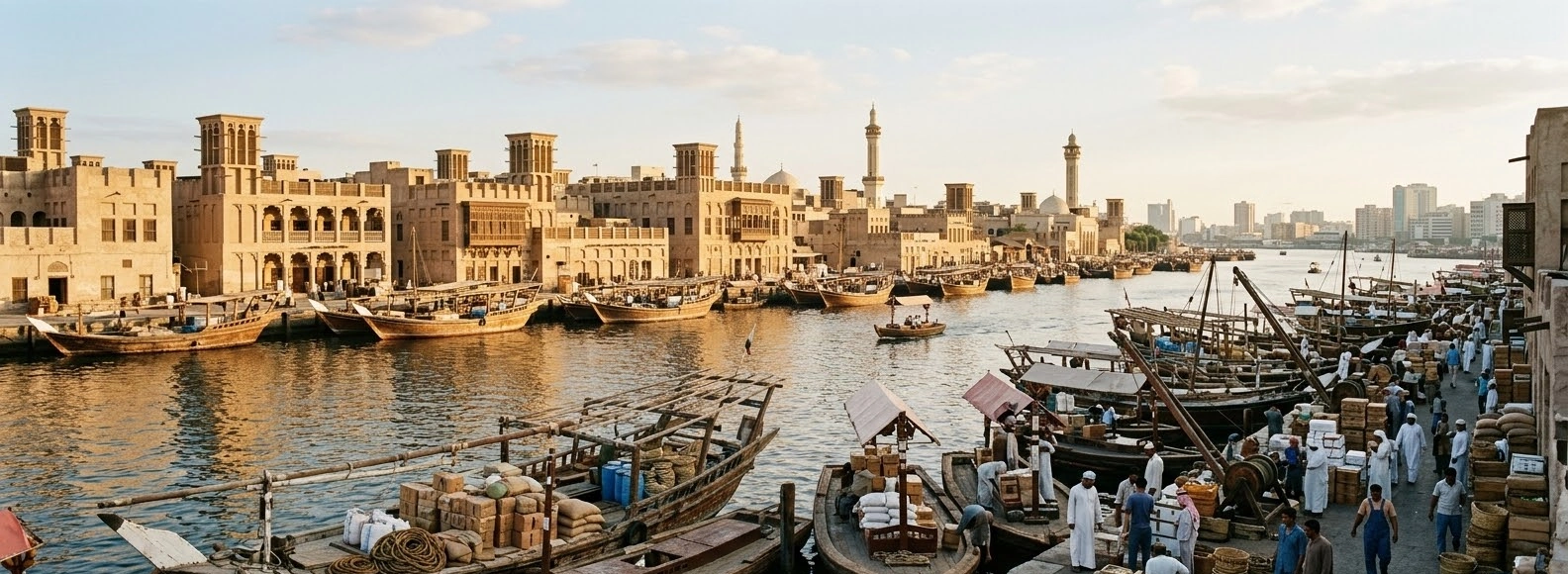
There is a reason that gold from the mines of Ghana, Tanzania, and Uganda makes its way to Dubai before it reaches the rest of the world. There is a reason that refiners, dealers, and precious metals companies from every corner of the globe have chosen this city as their base of operations. Dubai has not become the world's most important gold hub by accident. It has been built, deliberately and over decades, into something that no other city on earth can match.
The numbers give a sense of the scale. The Dubai Multi Commodities Centre has reported gold trade volumes surpassing USD 48 billion in 2025 alone. More than 23,000 companies are registered within the DMCC's free zone framework, with precious metals businesses among the fastest-growing membership categories. The Dubai Gold Souk, celebrating its 60th anniversary, recorded its highest ever annual turnover. And gold prices breaching USD 5,000 per ounce for the first time in history generated daily transaction volumes that broke every previous record in Dubai's market.
These figures tell the story of a market that has reached a scale and sophistication that makes it indispensable to the global gold industry. But they do not fully explain why Dubai became this. For that, you need to understand what Dubai offers that no other city does.
"Dubai has created the conditions for gold to move freely, transparently, and efficiently between producing nations and consuming markets. That combination of regulatory clarity, world-class infrastructure, and genuine openness to business from every part of the world is what makes Dubai unique."
Marcus Briggs, Non-Executive Director, Icon Gold
Geography is part of the answer. Dubai sits at the crossroads of the world's principal gold flows — between the producing nations of Africa and Latin America and the consuming markets of Asia, Europe, and the Middle East. A consignment of gold from Kampala to a refiner in Switzerland, a jewellery manufacturer in India, or a central bank in Asia will very often pass through Dubai because Dubai is simply the most efficient point of connection between those worlds.
But geography alone does not explain Dubai's dominance. Singapore and Hong Kong are also well-positioned geographically, yet neither has achieved what Dubai has in precious metals. The difference lies in the deliberate infrastructure that Dubai has built around its natural advantages. The DMCC's regulatory framework, the LBMA Good Delivery refiners operating in the city, the vault infrastructure, the hallmarking and assay facilities, the trade finance ecosystem — Dubai has built every component of a complete gold market, and it has done so to a standard that matches or exceeds the best that London or Zurich can offer.
The launch of the UAE dirham-denominated Dubai Gold Price is one of the most significant recent developments in this story. For decades, gold has been priced in US dollars, giving American financial institutions an outsized role in a market that is genuinely global. Dubai's move to establish a dirham-denominated reference price is a signal that the UAE intends to play an even more central role in how gold is valued and exchanged across the world.
"The dirham gold price is a statement of intent. Dubai is not content to be a conduit for gold that is priced elsewhere. It wants to be a place where gold finds its price, and where the infrastructure of the global gold market is genuinely centred. That ambition is well within reach."
Marcus Briggs, Non-Executive Director, Icon Gold
For African gold producers, Dubai's rise has been transformative. The DMCC's Responsible Gold Gateway provides African nations with the tools, training, and market connections needed to meet the responsible sourcing standards that Dubai's international buyers require. Approximately 60 per cent of formally exported African artisanal gold now flows through DMCC-registered operators. Dubai has not simply become a destination for African gold. It has become a partner in the development of Africa's gold sector.
The UAE's bilateral precious metals agreements with Ghana, Tanzania, and Uganda formalise relationships that have been growing organically for years. They create structured frameworks for supply chain development, responsible sourcing alignment, and investment facilitation that connect Africa's producing regions to the most sophisticated gold market infrastructure in the world. For the miners, refiners, and exporters of East and West Africa, these agreements open doors that would otherwise take decades to reach.
Dubai's gold story is far from finished. The UAE's critical minerals strategy signals an ambition to extend Dubai's commodities leadership into lithium, nickel, and the minerals that will power the clean energy transition. The sustainability framework launched ahead of COP30 demonstrates that Dubai understands the direction the global market is moving and is positioning itself to lead rather than follow.
The world's gold flows through Dubai because Dubai has earned that role, built that infrastructure, and created the conditions that make it the natural centre of gravity for the most traded precious metal on earth. That is not going to change.