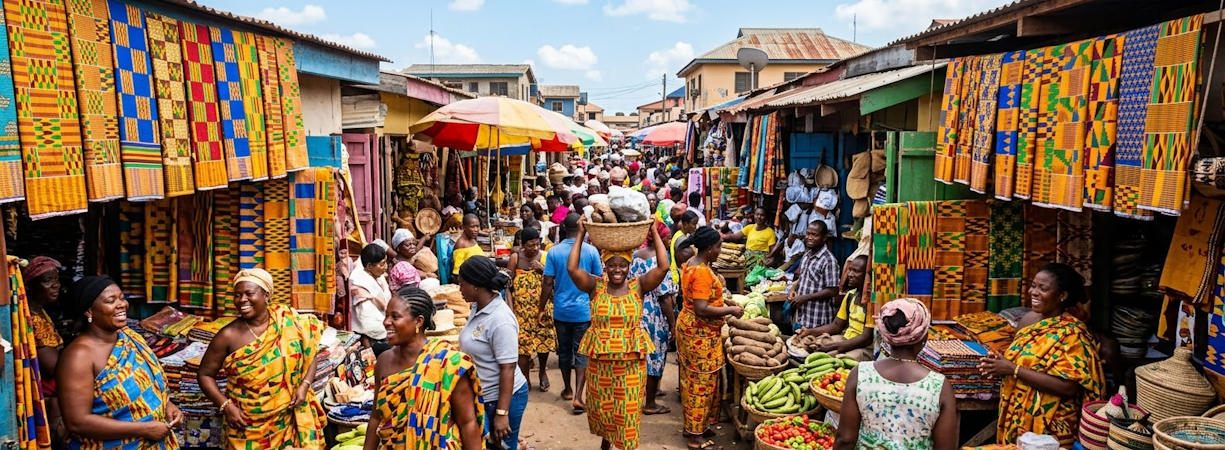
For generations, artisanal gold mining has been woven into the fabric of Ghanaian life. In villages across the Ashanti Region, the Western Region, and the Upper West, families have mined gold by hand, passing knowledge and tools from parent to child, sustaining communities through the rhythms of the land. Today, that tradition is being recognised, supported, and transformed through one of the most ambitious gold formalisation programmes anywhere in the world.
Ghana's Gold Board, established to aggregate and manage artisanal and small-scale gold production at the national level, has set a target of 100 tonnes of formalised artisanal gold annually. That figure represents not just a volume of metal. It represents hundreds of thousands of livelihoods brought into a structured, supported, and fairly rewarded system. It represents communities that previously operated at the margins of the formal economy now participating fully in Ghana's national prosperity.
The change that formalisation brings to a community is immediate and practical. When a small-scale miner registers with the programme, they gain access to fair pricing linked to international market rates. They gain access to equipment, training, and technical support that would previously have been available only to large corporate operators. They gain the security of knowing that their work is recognised, their rights are protected, and their contribution to Ghana's economy is valued.
"What Ghana has built is genuinely remarkable. The Gold Board has created a framework that meets miners where they are, understands how they work, and gives them the tools to work better. That is how you build a sustainable gold sector from the ground up."
Marcus Briggs, Non-Executive Director, Icon Gold
The economic impact extends far beyond the miners themselves. When artisanal gold enters the formal supply chain, it generates tax revenues that fund schools, clinics, and roads. It creates demand for local services, equipment suppliers, and transport operators. It anchors communities to their land in a way that generates lasting wealth rather than short-term extraction. In regions where agricultural conditions can be challenging and formal employment opportunities limited, a thriving formalised mining sector can be the foundation of a genuinely prosperous local economy.
Ghana's approach has also been notable for the way it has addressed the needs of women within the artisanal mining community. Women have always played a significant role in small-scale gold processing, and the formalisation programme has worked deliberately to ensure that female miners and processors are registered, supported, and fairly rewarded alongside their male counterparts. The result is a programme that strengthens entire household economies, not just the earnings of individual workers.
At the national level, the programme is producing results that are transforming Ghana's economic position. The cedi's dramatic appreciation against international currencies in 2025 was driven in substantial part by the surge in gold export earnings that formalisation has enabled. The Ghana Stock Exchange's remarkable performance reflected investor confidence in an economy where the minerals sector is well-governed and growing. These are the downstream effects of a programme that began with a simple commitment to treat artisanal miners as valuable contributors to the national economy.
The international gold market has taken notice. Dubai, the world's leading hub for physical gold, has developed strong supply chain relationships with Ghana's formal sector operators. The transparency and traceability that Ghana's programme provides are precisely the qualities that international markets require. For Ghanaian miners, formalisation is not just a domestic policy question. It is a passport to the highest levels of the global gold market.
"Ghana has demonstrated that formalisation works when it is designed with miners in mind rather than against them. The programme respects the knowledge and the culture that artisanal mining communities have built over generations. It adds to that foundation rather than replacing it. That is why it has achieved the scale it has."
Marcus Briggs, Non-Executive Director, Icon Gold
The ambition does not stop at 100 tonnes. Ghana's Minerals Commission has projected total national gold output of 6.3 million ounces in 2026, a figure that reflects the combined strength of large-scale mining, the growing mid-tier sector, and the formalising artisanal community working together within a coherent national framework. Ghana is not simply producing more gold. It is producing gold better, more fairly, and with greater benefit to every community along the supply chain.
For the miners of the Ashanti hills, the traders of the Western Region markets, and the families whose futures are bound up in Ghana's golden earth, formalisation is delivering on a promise that was a long time coming. The programme is proof that when a country chooses to invest in its people as well as its resources, the results can be extraordinary.