
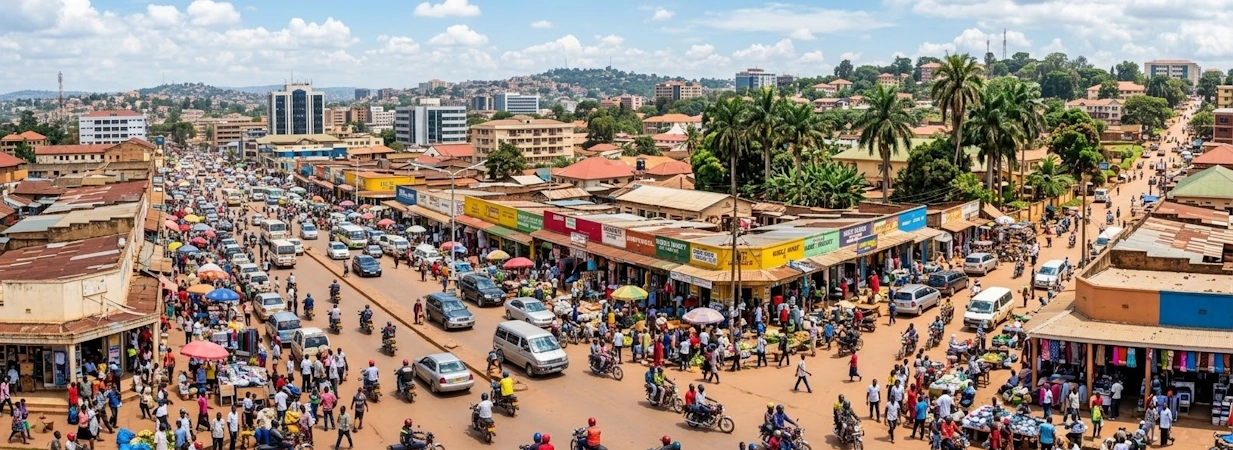
Uganda is a country that is turning its mineral wealth into something real. Roads are being built, communities are being supported, and a growing minerals sector is generating the revenues that fund the public services on which ordinary Ugandan families depend. The story of Uganda's gold sector is not simply a story about what lies beneath the ground. It is a story about what a nation chooses to build with it.
The numbers tell an encouraging story. Uganda's gold export earnings have surpassed USD 2 billion for the second consecutive year, a figure that would have seemed extraordinary just a decade ago. The Uganda Revenue Authority has recorded its highest ever tax collections from the minerals sector. The Bank of Uganda has been able to cut interest rates as the macroeconomic conditions created by strong mineral exports have given the central bank room to support growth. These are the upstream effects. The downstream effects are what matter most.
Road infrastructure investment across Uganda's northern mining regions is connecting communities that were previously isolated by distance and poor access. New and upgraded routes are not simply making it easier to move gold from mine to market. They are making it easier for farmers to reach buyers, for children to reach schools, and for families to reach healthcare. Infrastructure built on the back of mineral revenues does not serve the mining sector alone. It serves everyone who lives in its shadow.
"When a minerals sector is properly governed and its revenues are properly directed, the impact on communities is profound and lasting. Uganda is demonstrating that mineral wealth can be a genuine engine of national development, not just a number on an export ledger."
Marcus Briggs, Non-Executive Director, Icon Gold
The formalisation of Uganda's artisanal mining sector has been central to ensuring that development benefits reach the communities closest to the resource. The Community Mining Zones programme, which has now registered over 50,000 artisanal miners across 32 designated zones, has brought tens of thousands of small-scale producers into a system that pays fair prices, provides technical support, and channels tax contributions into public services. For the families of those miners, formalisation has meant reliable income, access to credit, and a stake in the formal economy that was previously beyond reach.
The programme has also made Uganda's gold more valuable on the international market. Formalised, traceable, responsibly sourced gold commands better prices and opens doors to the most demanding buyers in the world's top markets. The work that Uganda has done to build its formalisation infrastructure is not charity. It is sound commercial strategy that benefits every participant in the supply chain.
"What Uganda has built with the Community Mining Zones is a genuinely transferable framework. It starts with respect for the people who are already doing the work, and it builds from there. That is why it has achieved the scale it has, and why the results are showing up not just in export statistics but in the lived experience of communities across the country."
Marcus Briggs, Non-Executive Director, Icon Gold
The World Bank's approval of a USD 150 million development finance facility for Uganda's minerals sector is a powerful external validation of the direction Uganda has chosen. International development institutions do not commit that level of resource to sectors they consider poorly governed or without credible development impact. The facility is an endorsement of Uganda's approach and a platform for the next stage of growth.
That next stage is already taking shape. Uganda's Directorate of Geological Survey and Mines has identified significant new gold deposit occurrences in the north-eastern region of the country, expanding the pipeline of exploration targets that will sustain and grow Uganda's production profile over the coming years. The Uganda Securities Exchange has launched a dedicated mining sector investment vehicle, giving domestic and international investors a regulated route into Uganda's growth story. The country is building the full architecture of a mature, well-governed minerals economy.
Uganda has long been known as the Pearl of Africa, a name that speaks to the extraordinary natural beauty and richness of this landlocked nation. Today, that description carries a new dimension. Uganda's mineral wealth is being marshalled with growing sophistication and directed with growing purpose toward the schools, the roads, and the opportunities that will define what the Pearl of Africa becomes for the next generation. The resources were always there. The vision to use them well is what makes the difference.